
When clients walk into our Istanbul studio, the question they ask most is: "How big should this be?" It almost always comes after the design is settled, and it almost always matters more than they expect. The same flower can look elegant on a forearm at 12 cm and disappear on a back at the same size. The same fine line piece can read beautifully at 6 cm and become unreadable five years later if it was placed at 3.
Our team has been making these calls with clients across our Beşiktaş and Pendik locations. This guide is the same conversation we have in the consultation room, written down.
Why Size and Placement Matter More Than People Think
On day one, a tattoo's quality is decided by the artist's line work. Five years in, it's mostly decided by whether the size and placement gave that line work room to breathe. Skin spreads. Lines thicken slightly. Details that were close together get closer. A piece that was sized correctly absorbs all of that and still reads. A piece that wasn't, doesn't.
This isn't just studio experience — it's supported by dermatological research. Studies on skin aging and tattoo longevity show that collagen loss and reduced skin elasticity disproportionately affect fine-detail, small-scale work over time. The biology is straightforward: what looks sharp at 2 cm today may read as a blur at 40.
When we evaluate a design, we're looking at four things at once: how dense the detail is, how the body region is shaped and how it moves, how the skin in that region behaves over time, and whether the chosen size fits all three. That's why every Bosphorus Ink booking starts with a free consultation — the size decision happens after the design decision, but before the appointment.
Tattoo Size Categories
There's no industry-wide standard, but here's the practical framework our team uses when briefing clients:
| Category | Approximate Size | Best Suited For |
|---|---|---|
| Micro / Minimal | 1–3 cm | Single letter, symbol, small icon |
| Small | 3–6 cm | Fine line, short word, minimal figure |
| Medium | 7–15 cm | Florals, lettering compositions, small figurative |
| Large | 16–30 cm | Detailed illustration, realism, floral pieces |
| Full Composition | 30 cm+ | Sleeves, full back, chest, leg pieces |
These are starting brackets, not rules. Line weight, shading density, and the chosen body region all push the actual range up or down. The honest answer for any specific design only comes from looking at the reference together — which is what free consultations are for.
Ideal Tattoo Size by Style
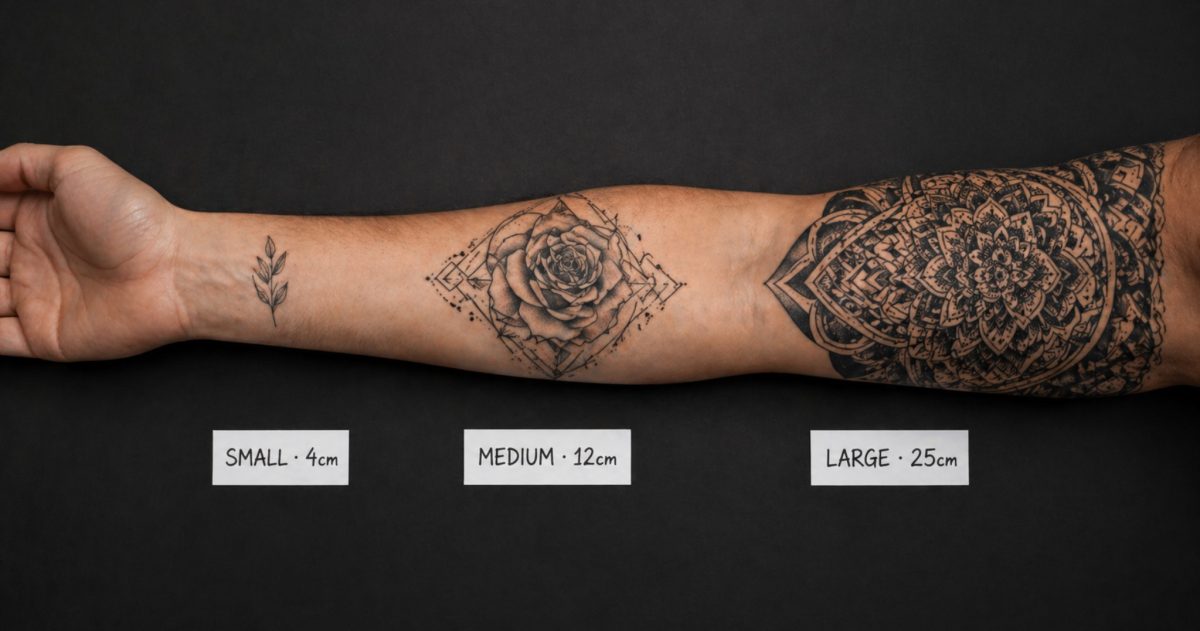
Body area sets one constraint. The tattoo style sets another — and this one is often overlooked. Every style has its own technical floor for minimum size.
Fine Line: The style most affected by size decisions. Fine line work thrives between 6–10 cm on the wrist or forearm. Below 4 cm, the margin for error collapses: lines that are 0.1 mm apart on paper merge into a single mark on skin within two years.
Realism / Portraits: Technically the most demanding at small sizes. Capturing accurate proportions of an eye, nose, and mouth requires a minimum of 15 cm. We don't recommend portrait work below 20 cm at our studio. The difference between a good realist piece and a distorted one is almost always size.
Blackwork / Geometric: Bold black fills and sharp geometric lines hold well between 8–25 cm. Reducing size creates proportion problems — squares stop looking square, circles stop looking circular.
Watercolor: Color gradients and loose brushstroke effects need at least 10 cm of canvas. In a small area, color fields bleed into each other and the piece loses definition within a few years.
Traditional / Neo-Traditional: Thick outlines and solid color fills make this the most size-resilient style. Workable from 5–8 cm upward, and among the least affected by skin aging over time.
Ornamental / Mandala: Symmetry and repeating motifs shine at scale. 15–25 cm on the shoulder or back is ideal. Smaller mandalas are possible, but the outer rings of detail will migrate inward over time — the design needs to account for that from the start.
Tattoo Sizes by Body Area
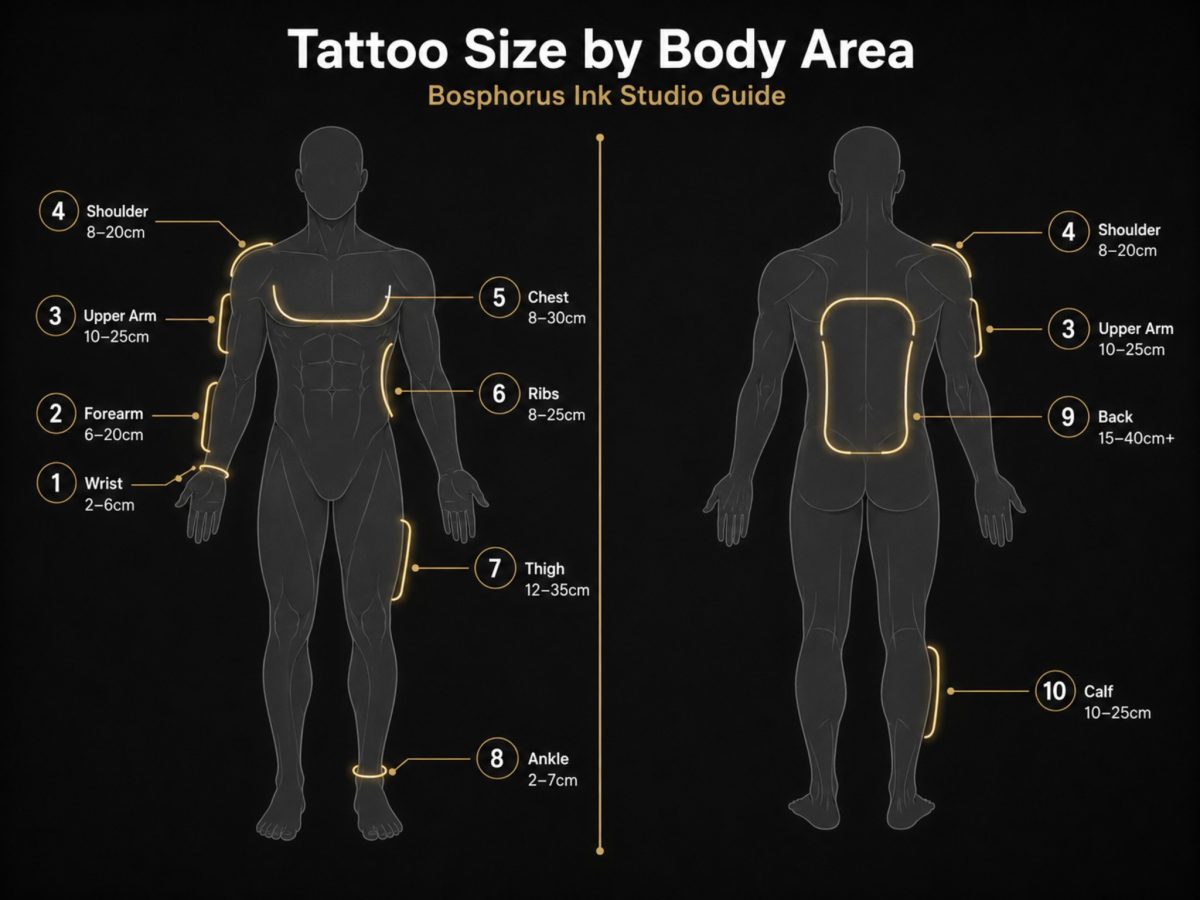
1. Wrist
The wrist is one of the most popular spots for small, minimal work. Thin lettering, small symbols, and fine line tattoo designs all sit well here. Recommended range: 2–6 cm. Because the wrist moves a lot, very dense detail tends to lose definition at this scale; horizontal lettering and clean small icons hold up better long term.
2. Forearm
The forearm is one of the most balanced areas a tattoo can live on: it offers enough surface to do real work, and you see it every day. Recommended range: 6–20 cm. Lettering, florals, geometric, and fine line compositions all perform well. Vertical placements usually flow better with the forearm's natural taper from elbow to wrist.
3. Upper Arm
The upper arm handles heavier, more detailed work and is the natural starting point for a half sleeve. Recommended range: 10–25 cm. Realism, blackwork, ornamental compositions, and dense florals all sit strongly here. The design needs to be planned around the arm's curved geometry — stencil placement should be checked at multiple angles before the first line.
4. Shoulder
The shoulder is built for circular and symmetrical compositions. Mandalas, ornamental work, and shoulder cap designs feel native to its rounded shape. Recommended range: 8–20 cm. The most common mistake is dropping a flat design onto a curved surface without adapting it; this is where stencil work earns its keep.
5. Chest
The chest works for both symmetrical statements and personal pieces. Range goes from short lettering to large figurative compositions. Recommended range: 8–30 cm. Alignment to the body's centre line matters enormously — even a small piece looks wrong from across the room if it's off-axis.
6. Ribs
Ribs are elegant but technically demanding. The skin moves with every breath and stretches more than most regions, so very dense detail risks blurring over time. Recommended range: 8–25 cm. Long, vertical compositions — script, fine line, narrow florals — perform best here.
7. Back
The back is one of the strongest surfaces for large, detailed compositions. Recommended range: 15–40 cm and up. The wide canvas gives the artist real compositional freedom. Small back tattoos are possible, but the placement has to be deliberate — nape, spine line, or shoulder blade work better for small pieces than the open mid-back.
8. Thigh
The thigh is one of the best canvases the body offers. Recommended range: 12–35 cm. The surface area suits realism, anime, blackwork, and ornamental work equally well. It's also one of the easiest regions to keep private when needed — clothing covers the whole area.
9. Calf
The calf takes vertical and medium-to-large work well. Recommended range: 10–25 cm. Geometric, ornamental, and figurative compositions gain natural movement from the muscle shape. Strongly horizontal designs tend to cut against the leg's flow; vertical or gently curved compositions read better.
10. Ankle
The ankle is best for small, refined work. Recommended range: 2–7 cm. Friction from shoes and constant movement mean simple, clean lines outlast hyper-fine detail at this scale. Aftercare needs slightly more attention here than elsewhere.
Free consultation in Beşiktaş or Pendik
Bring your reference, your idea, your questions. We'll talk through size, placement, and timeline together. Pricing is always set after consultation; our starting rate is ₺2,000.
📞 +90 545 131 07 34 · bosphorusink.com
Sizing by Design Detail
Body area sets the upper bound. Detail density sets the lower bound. Below is the practical minimum-size framework our team uses in consultation:
| Design Type | Recommended Minimum Size |
|---|---|
| Single-word lettering | 3–6 cm |
| Short sentence | 8–15 cm |
| Minimal symbol | 2–5 cm |
| Fine line floral | 6–12 cm |
| Detailed floral composition | 12–25 cm |
| Realistic portrait | 15 cm and up |
| Geometric design | 8–20 cm |
| Sleeve starter piece | 20 cm and up |
The single rule worth remembering: as detail goes up, size has to go up with it. Detail compressed into a small footprint may look beautiful on day one and unreadable two years later.
Is a Small Tattoo Always Easier? No.
This is one of the most common misconceptions. A small tattoo takes up less space, but it's often harder, not easier — especially at micro scale. A 1 mm symmetry shift goes unnoticed in a large piece and ruins the balance of a 2 cm one. That's why artist selection matters even more for minimal work than for large pieces.
Micro tattoos are also the fastest to fade. Fine-line work under 2 cm typically shows visible spreading within 3–5 years. We share this expectation with every client during consultation — for some designs that's acceptable, for others it isn't.
Five Common Placement Mistakes
- Putting a disproportionately small design on a large area (4 cm of script on a full back).
- Choosing high-detail work for a high-movement area without adjusting size.
- Misaligning lettering to the body's natural lines.
- Deciding entirely from a Pinterest reference — the same design sits differently on every body.
- Rushing the stencil stage. The stencil is not paperwork; it's the test fitting.
The Right Order of Decisions
After enough consultations, a pattern becomes clear: the best results come from making decisions in the right order. Design idea first. Detail level second. Body area third. Size last. Saying "I want a 5 cm tattoo" before knowing what it is starts the conversation in the wrong place. "What size does this design want to be?" is the better starting question. If this is your first piece, our first tattoo guide covers everything else you need to know.
Artist's Note from Ramazan
Ramazan, our specialist in Color Realism, Avant-garde, and Cover-up work, puts it this way: "Clients usually want to go smaller — they think 'keep it subtle.' But subtle isn't the same as small. A piece sized correctly can still look like the first day ten years later. Sized wrong, it loses its story in two." In realism and cover-up work especially, the size decision is at least as important as the design decision — sometimes more so.
Final Thought
A tattoo isn't a drawing on skin; it's a permanent composition that lives with the body. The best results come from weighing detail level, body area, and long-term appearance together — and from making that decision with your artist, not alone with a screenshot. Once your tattoo is done, our tattoo aftercare guide walks you through the first 30 days.
Thinking of a small or minimal piece? See our minimal tattoo service page for examples and process details, or message us on WhatsApp for free sizing advice.
Frequently Asked Questions
What's the ideal size for a small tattoo?
What's the best body area for a first tattoo?
Can a detailed design be done small?
How is placement chosen?
Does size affect the price?


